
Why you should learn accents as an actor

At some point in your acting career you will certainly come across an audition where you’re asked to do a specific accent. If you have no experience with accents whatsoever, you might miss out on some really exciting opportunities. Your lack of accent experience and more importantly your lack of confidence might cause you to overthink the pronunciation of every single word in such an audition. As a result, you can’t focus on what you’re really there for: demonstrating your amazing acting skills.

There are so many accents in the English-speaking world and it can be daunting to even know where to begin learning a new accent. There are a few regularly requested accents in the industry, such as Standard American English (aka General American) or Standard British English (aka Received Pronunciation or RP). So if you don’t have any experience with accent work, one of these two might be a good accent to start with. But to be honest, it doesn’t really matter where you start. The fun thing about accent work is that you can build on it endlessly! Learning one accent will give you tools, experiences and know-how that will make it so much easier to learn another one. And knowing two accents will make it that much easier to learn a third one. And another one after that, and another one then etc. etc. Basically: the more accents you have experience with, the more easily you can tap into any accent. By learning an accent today, you’re making it so much easier for Future You.

If you’re already familiar with standard accents, you might want to think about adding regional accents to your tool belt. Regional accents add a layer of depth to characters that the above mentioned standardised accents just can’t do. Language and dialect are inherently linked to culture. Different ways of life are reflected in the words we use as well as how we pronounce them. Learning a new accent gives you an insight into other cultures and as such gives you a deeper understanding of the kaleidoscope of human experiences. When you play a character, you represent real-life people and in order to do that respectfully it’s crucial to understand who you’re representing. Accent work can give you a window to look into your character’s world and it can make your character work more authentic and therefore more believable.

In conclusion, even if you don’t have an upcoming project that requires a specific accent, it’s never a bad idea to learn a new accent as an actor. It will give you skills and confidence that will pay off time and time again. But don’t feel like you have to do it on your own! Learning a new accent is hard. Full stop. You’re not expected to sew your own costume or do your own make-up for a role, so you really shouldn’t be expected to learn accents on your own either. Ideally, when you book a role with a specific accent that’s not your own, the production should provide you with a dialect coach. (Sadly, that’s not always the case but that’s a whole other story). In the meantime, dialect coaches, like me, LOVE helping actors learn new accents. That’s our jam! We have detailed linguistic knowledge of tons of accents, and extensive experience teaching other people how to achieve the facial movements and sounds required for these accents. Whether you’d like to learn a new accent from scratch to expand your repertoire in regular sessions, or if you’d just like to have someone in your back pocket to go over your lines together for that next audition requiring accent work, we are here to help!

So why not reach out to a dialect coach today? (It doesn’t have to be me although I would love to work with you of course 😊 Feel free to reach out here).


The value of a catchphrase

(This blog post describes an exercise that I often use with my clients. If you’re interested in seeing more accent practice exercises, check out my digital product “How To Practice Accents” here)

Sometimes the hardest thing when attempting a new accent is just starting your sentence. You can’t help but have a nervous feeling that hinders you from speaking in your target accent off the cuff. But no need to worry! There’s a nice little trick to overcome that feeling and that’s to use a catchphrase.

Imagine you’re about to jump into a pool from a diving board. The first time, you’re probably nervous about the jump and walk back and forth on the board a few times considering the best way to muster up the nerves to jump. The second time, you’re perhaps still a bit hesitant but you walk down the diving board and bounce on it a couple times. Remembering that your first jump wasn’t so bad after all, you jump a little more quickly on your second jump. With each jump, you get less nervous until you don’t even remember being nervous in the first place. The diving board is always there to boost your confidence, prepare you for your jump and give you an extra bit of energy before you launch into the water.

You might be just as nervous or uncomfortable trying to speak in your target accent for the first time. Especially early in your accent learning journey. But you can manage your nerves by coming up with an “accent diving board” that boosts your confidence and gets you ready to speak in your target accent. This “accent diving board” should consist of a few words or sentences that you know you can say perfectly in your target accent. We often call this a catchphrase or springboard sentence/words.

Your catchphrase can be a completely random word that you associate with your target accent, or it can be a little phrase that you observed when listening to one of your target accent speakers. It’s great if your catchphrase contains a few of your target accent’s signature sounds but don’t feel like you have to force this. Your catchphrase can change over the years or with each project as well, so just choose one that feels good right now. Once you’ve chosen a catchphrase, say it out loud before and during any practice session and especially anytime you feel like you’re losing the accent. Use your catchphrase in the same way you use the diving board to boost your confidence on your jump into the water. Your catchphrase also prepares your facial muscles and your brain for switching accents.

Go ahead and search for a few words or sentences that you can use as your catchphrase. And then use it the next time you feel hesitant before trying to speak in your target accent, or whenever you feel like you’re losing the accent in the middle of your practice. Here are some of my favorite catchphrases I’ve been using for different accents over the years:

General American:

tomato sauce – Merry Mary’s getting married – Oh my God!

New Zealand:

sweet as – bottle of water – You egg!

Classic RP:

it’s a bit too early in the evening don’t you think – remember to remain composed

Scottish: alright – it’s a girl’s world – that’s what their saying

See how truly random and silly these catchphrases can be – they don’t have to make sense to anybody but YOU 😊


The first thing to nail when learning a new accent

Learning a new accent is hard. Even for those with a natural affinity for picking up new accents, it takes time and a lot of practice. There’s many approaches to learning a new accent and it’s difficult to know where even to begin on your accent learning journey. A great starting point is what we call oral posture, or in other words: how to use your facial muscles for different accents. Understanding this will make any subsequent steps much easier to learn and that’s why it’s the first thing you’ll want to master when learning a new accent.

We don’t often think about our facial muscles – they’re small and we usually speak without being aware of what exactly our mouth is doing. They are muscles just like your bicep or hamstring but you’d never think about including them in your workout at the gym. Yet, you use them every day when speaking and therefore actually work them out more often than many of your other, bigger muscles. This facial muscle workout is tailored specifically to all the sounds particular to your language, your accent, and your idiolect. As a result, you build up strength in certain areas of your face while keeping other muscles more relaxed. This frequent workout results in a very specific setting of your facial muscles, something that is often referred to as oral posture. It’s the perfect base setting for the vowels and consonants YOU use everyday when you speak and it acts like a filter through which your every sound is released into the world. Your personal oral posture allows you to produce YOUR vowels and consonants in a manner unique to your accent, and to do so while being 100% comfortable with it.

Now here’s the thing: a speaker of a different accent is doing an entirely different facial muscle workout every day and as a result, they have a very different oral posture than you! They’re using different muscle movements when they speak and as a result, build strength in different areas of their face. Their “filter” is perfectly tuned to the vowels and consonants THEY use every day. This is why, when you learn a new accent, the first thing you should do is learn a different workout for your facial muscles. Without changing your oral posture, you won’t be able to produce the sounds of a new accent comfortably. For example, if your own oral posture is naturally quite tight with a lot of tension in the jaw and lips, it will be very hard for you to pronounce very open and relaxed sounds that are needed for other accents. You first need to change your oral posture to accommodate for those open and relaxed sounds.

When you use your target accent’s oral posture rather than your own, on the other hand, all the vowels and consonants will already start falling into place and as a result it’ll be so much easier for you to produce these new sounds comfortably. As an actor, it’s especially important to always stay in your target accent’s oral posture when you’re in character as it’ll allow you to quickly jump into your target accent without having to remember how to say every single word.

Find your target accent’s hesitation sound

In order to find out how to change your oral posture, you need to know two things: 1) how you normally use your facial muscles, and 2) how speakers of your target accent use their facial muscles. A good way to find out the oral posture of an accent is the hesitation sound. This is the sound we make involuntarily when we don’t know what we want to say next. It often just slips out without us actively forming a specific sound with our facial muscles and therefore it’s the most relaxed sound your face can make. In another accent, some muscles might be more tense or more relaxed by default and therefore their most relaxed sound looks and sounds very different from yours. Observing a speaker’s hesitation sound gives you a glimpse at their default muscle settings – which muscles tend to be always tense, which ones are more relaxed and so on. It gives you a snapshot of the “filter” that colours every single one of that speaker’s vowels and consonants. 

I want to show you 3 examples of 3 different accents: Standard British English, General American, and Glaswegian.

Watch excerpts of the three videos below and focus only on how the speakers are using their facial muscles. What tendencies can you see? How open or closed is their mouth generally? Or how wide? How often do they round their lips when speaking? How much of their teeth are generally visible? Can you see any tension in their cheeks? See if you can find their hesitation sound to get a good idea of the base setting of their facial muscles.

1) Standard British English – Emma Watson:

2) General American – Amy Adams:

3) Glaswegian – Robert Carlyle

I took screenshots of these three speakers at the moment they were using their hesitation sound. Looking at the three pictures below you can immediately see how different each of their oral posture is:

The hesitation sounds of Standard British English, General American and Glaswegian

Emma Watson generally keeps her mouth fairly open, with a gap between her upper and lower teeth frequently visible. Her oral posture allows her to open her mouth very wide, which is necessary for her vowels in words like BATH or TRAP. In addition to that openness, she also has some tension especially in the lip corners and her cheeks. This makes it look like she always has a teeny smile when speaking.

Emma Watson’s hesitation sound

Amy Adams also keeps her mouth fairly open but opposed to Emma Watson, she doesn’t have much tension in her cheeks or lips. She just allows her jaw to drop loosely and her lips to move to different places flexibly. This makes most American vowels quite relaxed and stretchy, and also gives her the space to comfortably produce her American Rs.

Amy Adams’ hesitation sound

Robert Carlyle, on the other hand, doesn’t allow for much openness in his oral posture. He rarely opens the mouth to reveal his teeth and his oral posture is stretched horizontally, rather than vertically. As a result, you won’t hear him use many open vowels that are commonly used in the other two accents. This tight oral posture has an important effect on many vowels such as in words like GOOSE or MOUTH as well as on Glaswegian R and L sounds.

Robert Carlyle’s hesitation sound

Now, the above three examples show three completely different speakers, with completely different faces, so the oral postures I described above could just be the way they are because of each speaker’s personal facial structure. And to some extent, a person’s individual facial features of course can have an impact on the way they speak. But if you go and find videos of other speakers with similar accents to the three examples discussed here, you will see the same tendencies in how they use their facial muscles, even if their faces look completely different.

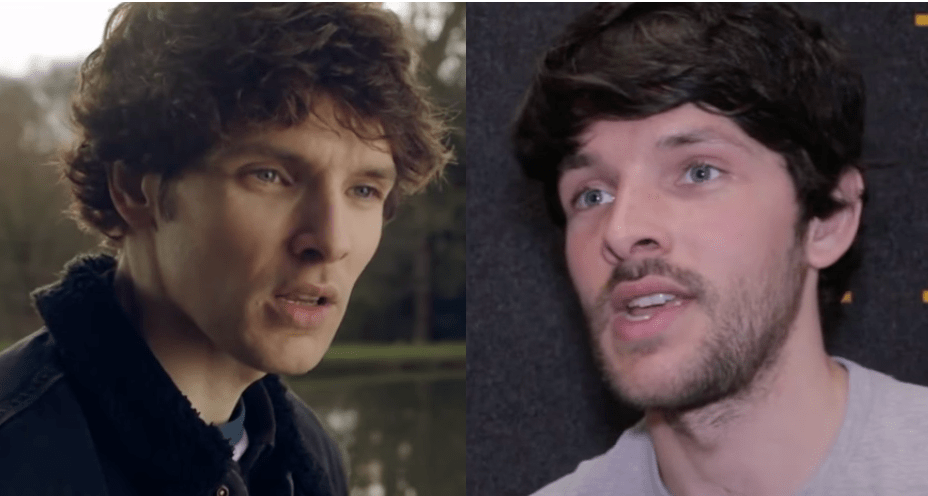
We can also observe the impact of oral posture by looking at the same speaker using two different accents. Colin Morgan is a great example of an actor who’s performed using many other accents successfully besides his native Northern Irish one. Compare the excerpt from Channel 4’s “Humans” below, where he’s is using a Standard British English accent, to his interview about “The Fall”, in which he’s speaking with his native accent. Can you see how he’s using his facial muscles in very different ways to achieve the different sounds of these two accents?

Colin Morgan’s base oral posture when speaking with a Standard British English accent (left), and when speaking with his native Northern Irish accent (right).

So there you go, now you know where to start when learning a new accent: Learn how to use your muscles in a different way. Easier said than done, you say? Changing the use of your facial muscles to such an extent is by no means an easy feat. We don’t pay attention to our facial muscles when we speak and we also usually don’t analyse other speakers’ muscle movements when they speak. It takes time and practice to know what fine nuances to look for, let alone to then implement changes to your own way of speaking. This is where working with a dialect coach comes in handy ;). We have years of experience in analysing other people’s speech patterns, know exactly what to look for and can help you get comfortable with new muscle movements. If you’re still unsure about where to start, reach out to me and let’s have a chat!

Scottish accents in A Castle for Christmas

Earlier this week I was invited to BBC Scotland’s The Nine to discuss the Scottish accents in Netflix latest Christmas hallmark movie A Castle for Christmas which had gotten quite some backlash from Scottish viewers critical of the Scottish accents in it. I had only seen the trailer at the time of the interview but this weekend I made myself a hot chocolate, got cozy and watched the full movie. Here are my thoughts on the Scottish accents in it:

Let me start by saying one very important thing people sometimes forget: Speaking in a different accent is HARD. It requires a lot of knowledge and practice and unless you’re constantly around your new target accent, it’s nearly impossible to deliver it authentically without any help. In my interview with BBC Scotland I said that the best Scottish accents are delivered by Scottish people. As an actor though, of course, speaking in a different accent for a specific character can be a nice challenge and being able to do different accents can open doors to a wider range of characters. That being said, if a production decides to hire non-Scottish speakers for Scottish characters, they should offer their cast the support (i.e. hire a dialect coach) necessary to deliver this performance authentically.

In addition to having the target accent expertise at hand, time and practice are crucial to deliver accents authentically. I can teach the basics of an accent to any actor in a few sessions but unless the actor is willing to practice and – very importantly – is given enough time to do so, the impact of the accent work will be limited. An authentic accent delivery needs to sound and feel second nature. Speaking in a new accent means that you’ll have to learn how to pronounce completely new sounds, in completely new patterns, and deliver them as if you’re completely used to them. And that means your facial muscles need to be 100% comfortable with the actions that make these sounds happen. That takes time and practice.

Think of it like yoga: the first time you try a new position it’s really hard and you’re not sure you’re doing it right and it feels uncomfortable because your muscles are not used to being in that position … YET. The second time it’s already a little bit easier and with each practice, it becomes more comfortable. Eventually you can get into that position very quickly and with ease. But if you don’t practice regularly, you will never be able to do it very comfortably and quickly. Speaking in a different accent is just like that but for your facial muscles.

One important feature of Scottish accents is the R sound. If your native accent is, let’s say, English or American (like Cary Elwes’ own accent) and you hear a Scottish accent for the first time, one of the first sounds that sticks out to you is probably the R sound. That’s because English or American accented speakers use a different sound for their Rs than most Scottish speakers. There are many differences between those R sounds but the biggest is that for an English or American R, we pull our tongue backwards and bunch it up towards our upper back molars, while in many Scottish accents, the R is pronounced similarly to a D sound and the tongue needs to stretch forward and touch the gums right behind your upper teeth. People attempting to do a Scottish accent often know the Rs need to be different and they might even know how to achieve such a sound with their articulators. But unless they have gotten enough time and practice to get their muscles completely used to that new forward-stretching quick tapping movement for Rs, they won’t be able to make their tongue flick up as quickly as a native Scottish speaker and it will sound off.

I suspect that Cary Elwes wasn’t given the necessary help or time to really get comfortable with all the Scottish sounds for this movie. Some of his vowels were great for a Standard Scottish accent, such as the vowel in “you” at around 1:40 mins in the trailer above, or the vowel in the second syllable in “mistake” at around 1:10 mins. But not being completely used to all the Scottish sounds can have a big impact on the overall delivery of an accent and this was especially apparent in Elwes’ R sounds in this movie. His tongue was often in the right place but it didn’t move quickly enough and therefore most of his Rs were over-enunciated, as can be heard when he says “here” at 0:45 mins in the trailer. Elwes’ Scottish accent in A Castle for Christmas is a solid start, and with a bit more time and guidance I’m sure he could have delivered a Scottish accent that a Scottish audience would gladly accept as one of their own.

How to do great Italian accents – ‘Big Night’

I recently watched Big Night because I heard it was a cozy little film for food-lovers. Little did I know that I was in for a dialect treat as well! The movie’s protagonists are two Italian immigrants who run a restaurant in 1950’s New Jersey, starring Stanley Tucci and Tony Shalhoub. I had no idea what to expect from this movie, really, so I was extra pleasantly surprised when it wasn’t only a FANTASTIC movie in and of itself, but the dialects in this movie were outstanding too. Often when actors are aiming for Italian accents, many go for the overly stereotyped Mario & Luigi-type (“It’s-a me, Mario”) accents but thankfully, the actors in Big Night didn’t. Instead, Stanley Tucci honoured his Italian heritage and created a film that delivered great, authentic Italian dialects, both in writing and acting.

First, I want to mention one thing done right in Big Night and that I wish was more common in movies and TV shows: The fact that we get to see Primo and Secondo actually speak English AND Italian. Primo and Secondo have been in America for a while by that point and you can see that they got accustomed to speaking English even with each other. Seeing these two immigrants also use their native tongue with each other and other Italian speakers in the movie is an accurate portrayal of bilinguals and adds authenticity and depth to the characters and the story. In many scenes the characters are using both Italian and English in the same conversation. This is called code-switching and an integral part of how bilinguals use language. You can see this type of code-switching in action in the beach scene closer to the end of the film when both Primo and Secondo speak Italian and English with each other, switching seamlessly between the two languages within the same sentence.

Secondly, I’d like to highlight a couple of things that all tie in to one bigger aspect of non-native accents: The fact that non-native English dialects are rarely completely consistent with their features.

The first feature where we can observe that inconsistency in non-native English accents is to do with verb conjugation in English. English has a remarkably simple conjugation system in the present tense. Most verbs are exactly the same for each person, with the exception of the third singular. That means that a verb like “to eat” will be conjugated as “I eat, you eat, we eat, they eat” but “she/he/it eats”. Many other languages have far more complex conjugation systems than that so non-native speakers of English are often relieved to find out that the verb rarely changes in English, and as a result that 3rd singular ‘s’ can easily slip their mind. This is why you can sometimes hear non-native speakers say things like “he eat” instead of “he eats”. I’m sure many English-speaking actors notice this feature about non-native accents and when they then try to imitate a non-native accent, the first thing they do is drop every single 3rd singular ‘s’. But while non-native speakers are prone to dropping that extra ‘s’, they don’t drop every single one. Often they will remember to add the ‘s’. Just every now and then it slips their mind. The over-generalization of features like this is always a tell-tale sign that the actor is not actually a non-native speaker. Both actors in Big Night did a fantastic job at keeping those 3rd singular suffixes inconsistent, sometimes pronouncing them, and sometimes not.

One really nice detail the actors in Big Night also did right was what’s called H-insertion. Anybody who knows a little bit Italian will know that there is no H sound in Italian. For example the word horrible translates into orribile in Italian. Hs are just not part of the Italian sound system. Additionally, the H sound in English is a very soft sound consisting of air leaving the mouth with only very little obstruction. If your articulators aren’t already used to making this soft action, it is a difficult sound to master. This is the case for many Italians so sometimes it’s just easier for them to drop the H sounds when speaking English. This way a word like here can sound like ear. But non-native speakers do know that dropping Hs is not technically correct in standard English (*it can be in other native English dialects though e.g. Cockney), so they try to pronounce them but here’s where English spelling isn’t very helpful either. Some English words have an H in spelling that is not pronounced either, such as in the words honest and hour. So not only will Italian speakers have to learn how to produce that sound with their articulators, they then also need to learn when to pronounce this sound when speaking English. As a result, Italians sometimes add an H sound in places where there actually is no H in English, so that a word like eat can sound like heat. In Big Night you can hear both Primo and Secondo insert such hyper-corrected Hs. But just like with the 3rd singular ‘s’, non-native speakers are inconsistent with their usage of Hs as well. Primo and Secondo don’t just drop every single H, sometimes they do pronounce it in the right places. They also don’t always insert an H where it shouldn’t be, only every now and then. Tucci and Shalhoub nail this in Big Night. One good example of this occurs around 15 minutes into the movie when you can hear Primo say “say hi for me!” with a clearly audible H sound in hi, immediately followed by a hyper-corrected H-insertion in “you go… hout? “.

The actors and writers of Big Night did many things so wonderfully perfect but making sure their characters’ English is inconsistent definitely deserves extra recognition. Not many movies pay that much attention to detail when it comes to non-native accents but it’s important if you want to respectfully portray a non-native accent and do it justice. It makes the characters much more authentic and believable and as such has a huge impact on the audience’s enjoyment of the film.

Finally, the writers of this movie also get some extra brownie points from me for one of my favorite phrases ever said by a non-native speaker in a movie, which is when Primo said: “Maybe I should make mashed potatoes for on the other side”, instead of saying “for the other side” clearly not fully understanding the concept of ‘side’ being short for ‘side dish’ in English in this context. Learning a new language is difficult and it is normal for non-native speakers to have learned one meaning of a word without knowing how it’s used in another context.

All in all: The dialect work we see in Big Night is just *chef’s kiss*!

Kiwi English and Chain Shifts

Last weekend I rewatched Thor: Ragnarok (aka the best Marvel movie out there) and I realized that I don’t just love this movie because it’s the perfect blend of funny, anti-colonialist, and action-packed but also because it includes some fantastic Kiwi accents with Rachel House as Topaz and of course Taika Waititi himself as Korg. New Zealand English accents sadly are not featured in many mainstream movies of the Northern hemisphere so they’re relatively unknown accents. But they are some of the most fun and beautiful accents (in my opinion) and deserve more recognition.

There’s a lot going on in New Zealand English phonology but in this short post I will only discuss three vowels that are very distinct in Kiwi English due to a fascinating phonological change called a chain shift. A chain shift refers to a series of sound changes that are connected to each other, i.e. when one vowel moves to a new position, another vowel is pushed or pulled away from its original place too. Chain shifts can include many different vowels – in one of the most famous chain shifts, the so-called Great Vowel Shift, pretty much every vowel in Middle English changed drastically. The chain shift I want to discuss here affected three vowels in New Zealand: TRAP, DRESS, and FLEECE.

Here’s what happened to these three vowels in New Zealand English within the last century :

New Zealand English Chain Shift of front vowels (TRAP, DRESS, and KIT).

This gif shows a so-called vowel trapezium which is a tool linguists use to depict approximate positions of vowels within our mouth. The trapezium represents your oral space, from the front of your mouth (=left side of the trapezium) to the back of your mouth (=far right side of the trapezium), as well as your hard palate (=top line) and the very bottom of your mouth (=bottom line). Where we put a vowel in this trapezium will show the tongue’s position, i.e. how high up or low your tongue is for that vowel but also how far back or how front in your mouth. New Zealand accents started out with a similar vowel trapezium to that of modern-day Received Pronunciation (RP) for the TRAP, DRESS and KIT vowels (depicted in brown in the above gif). That means that these tree vowels sounded similar to this:

TRAP, DRESS, and KIT vowels in RP

The first vowel that changed was the one in words like TRAP. This vowel started out being pronounced with quite an open jaw and the tongue resting comfortably in the front of the mouth behind the lower teeth. It then was gradually pronounced with a higher tongue position until it reached a very similar tongue position to DRESS vowels. Because of that, a word like bat in a New Zealand English accent sounds like bet to the American or British listener. You can hear Taika Waititi’s raised TRAP vowels as Korg in the above video in words like that, actually, gladiator, pamphlets or hammer.

You can imagine that TRAP vowels being pronounced so similarly to DRESS vowels can lead to quite some confusion. If bat sounds like bet, how do we know which word the speaker means? To create a clear distinction again, DRESS vowels moved out of the way, approaching the tongue height of KIT vowels. A New Zealand English speaker’s bet now sounds like an American or British English speaker’s bit or sometimes even beet. We can hear this tongue raising for DRESS vowels in Korg’s speech in words like yeah, friend, revolution, sense, perishes, let, weapons, or dead.

With this second vowel raising, DRESS vowels became too similar to KIT vowels and again to avoid misunderstandings, KIT vowels moved away from their original position. This time, however, the tongue was already very high up in the mouth, so there was really nowhere to go towards the top. So instead, the tongue retreated and moved towards the center of the mouth. This way, KIT vowels ended up being pronounced with a very relaxed tongue and now sound very similar to a schwa, i.e. the most relaxed sound your face can make which is a sound similar to the American hesitation sound ‘uh’ . Pronouncing KIT vowels so centrally is arguably the most famous Kiwi English feature, perfectly exemplified by the words fish and chips sounding more like fush and chups. You can also find these centralized and relaxed KIT vowels in Korg’s speech, for example in the words this, it, insect, scissors, interested, or is.

With all this moving around, the TRAP, DRESS, and KIT vowels underwent the following journey in New Zealand English:

The evolution of TRAP, DRESS, and KIT vowels in New Zealand English

Now that you know about these 3 distinctive vowels in Kiwi English, I’m sure you can find some more examples in the speech of everybody’s favorite prime minister Jacinda Ardern in the following video!

Jock’s accent in ‘Lady and the Tramp’

I just rewatched one of my favorite Disney movies from my childhood: Lady and the Tramp. This was actually the first time I watched this film in English, having previously only watched it in German. The German version only features a couple nonstandard accents so I was quite surprised to see so many characters with nonstandard accents in the English original!

Living in Scotland, I obviously had especially strong opinions about Jock’s Scottish accent so I thought I’d share a few of my thoughts. The sounds and placement of Scottish accents are very different from North-American accents and it’s difficult to nail them without any help. Working with accent coaches wasn’t really on the radar when this movie came out in the 50s so considering that Jock’s voice actor, Bill Thompson, did it all by himself, it’s actually a pretty okay result. Thompson clearly picked up on some distinct Scottish features like the FACE and GOAT vowels and he knew that he needed to change his R sounds. Nevertheless, there were a few things that he could have improved to sound more like an actual Scottish speaker.

First, I want to talk about the feature that sticks out the most: Jock’s trilled Rs! Thompson rolled every single R with the tip of this tongue for Jock’s speech, and as a result the Rs are elongated and stick out from all the other sounds. While I have to say it is impressive how perfectly Thompson trilled every single R (it’s not an easy sound to make for many English speakers), trilling Rs like that is actually quite rare for Scottish English speakers. In all my years here I’ve actually never heard such trilled Rs and even in the early 20th century, not many Scottish speakers would’ve trilled their Rs as consistently as Jock did in Lady and the Tramp. This cute wee granny in the video below only truly trills her R a couple of times, for example in the word rules and here.

Trilling Rs like Thompson does in Lady and the Tramp takes a lot of effort and slows down your speech quite a bit. So to make things easier, what many Scottish speakers like this granny often use instead of trilled Rs is the so-called tapped R. It’s quite similar to the trill, but instead of a continuous up and down, your tongue only flicks up to the alveolar ridge (i.e. right behind your teeth where the gums start) once and very briefly. A really good example for the difference between the trill and the tap can be observed in Spanish for the words pero (tapped R) and perro (trilled R). So in conclusion: while Thompson clearly knew that he needed to change his R sounds for Jock’s speech, he was missing the nuance of just how often and how strongly to roll his Rs to really sound like a native Scottish speaker.

Secondly, the feature that really gave away that Bill Thompson is a native North-American English speaker was the way he pronounced his LOT vowels. In many North-American English accents, the vowel in words like not, hop, or sock has lost its rounding so it sounds more like the vowel used in words like palm or father. You can hear this in the little video below when Jock says “a bonnie new collar” (around 1:29 mins) with a very open, unrounded ‘aah’ sound in that first syllable of the word collar.

~ 1:29 mins: Jock says “a bonnie new collar” with a typical North-American unrounded LOT vowel

In Scottish accents, on the other hand, that vowel is pronounced with rounded lips so that lot and collar will sound like this

instead of being very open with relaxed lips in a General American accent:

Thompson consistently used his own unrounded LOT vowel which makes me think he really wasn’t aware of how much this vowel differs between the two accents. Having the help of an accent coach can really make a difference for things like this.

Finally, one thing I was really pleasantly surprised by was how often Jock used Scots words and grammatical features like bairn (=child) and dinnae (=don’t). There’s not enough Scots speakers on screen as it is so – even though most of the Scots words in Jock’s speech were quite typical and well-known – anytime a character speaks even just a little bit of Scots, I count that as a win.

On accent reduction and accent discrimination

As a dialect coach living in an international city like Edinburgh, I receive a lot of emails from non-native speakers requesting help to “reduce” their accent. This reflects a general tendency of non-native speakers feeling the need to modify the way they speak English. My clients fear they won’t be able to advance their careers if they don’t alter the way they speak and more generally their accents make them feel self-conscious. As a linguist, dialect coach and non-native English speaker myself it breaks my heart when I see any kind of accent discrimination. In response, I decided to share my thoughts on so-called “accent reduction” both as a linguist and a dialect coach.

I want to start first with discussing the term “accent reduction” because both the term and the practice are controversial. Firstly, I want to say that there’s really no such thing as “reducing” an accent. You can’t just erase some of your features – you will have to replace them with something else. So really, what accent “reduction” is (or should be in my opinion), is teaching you a NEW accent. That per se is not a bad thing. Learning a new accent is like learning a new language: a lot of fun and super interesting. But accent “reduction” regularly includes judgments as to which features are “correct” and which ones are not. It implies that some accents are more acceptable than others. Furthermore, the word “reduction” infers that your natural way of speaking is too much for people who are unfamiliar with your features to deal with it. It implies that your accent is overwhelming for them and that you should take it down a notch. There are two ways to tackle the issue of intelligibility between accents: 1) speakers of non-standard accents modify their accents, or 2) we normalize non-standard accents via increased exposure in media. Option 1) is the norm but why do we rarely see option 2)? “Accent reduction” is sometimes also referred to as “accent softening”, which isn’t any better because it implies that your native accent is too harsh and unpleasant. Because “accent reduction” and “accent softening” have these negative connotations, some accent coaches instead use the terms “accent modification” or “accent neutralization”. But even those terms still assume that there is an issue with your native accent in the first place that needs changing. If there is no term for this practice that doesn’t make it sound discriminatory it probably isn’t just the term itself that’s problematic. The practice itself is too, so it’s about time we changed that practice.

I often have prospective clients email me saying that they want to learn how to speak with a “neutral accent”. It takes time to undo this pernicious concept – there is no such thing. Every accent has certain things people associate with it. Even the prime examples that are taught as “neutral” accents, i.e. Received Pronunciation (RP) or Standard American English, are anything but neutral. If you learn how to speak with an RP accent, for example, you might fit right in at Buckingham Palace but when you use that same accent in let’s say Scotland or the United States, people there will still perceive you as an outsider. In short: The “neutrality” of an accent is relative to its surroundings. Therefore, if you want to learn a “neutral” accent, you first have to understand your environment and which accent might be perceived as “neutral” in your specific context.

Just as the neutrality of an accent is relative to its context, so too is its intelligibility. No accent is inherently unintelligible. It all depends on how exposed your listeners have been to your particular accent. Let’s take Scottish accents as an example. Sadly, it’s a trope in movies to have one token Scottish character that is not understood by other characters. The Scottish Disney princess Merida is a great example. In “Wreck-It Ralph 2– Ralph Breaks the Internet” there’s a scene where Vanellope meets all the Disney princesses . All the princesses are having a grand time chatting and laughing with each other but when Merida speaks, nobody seems to understand her. In her own movie “Brave”, however, Merida’s accent’s intelligibility is never questioned; everybody understands her every word. Opposed to all the other Disney princesses (who mostly speak with a Standard American accent), every character in “Brave’” is either Scottish like Merida, or is used to hearing Scottish accents every day. It seems like all the other Disney Princesses haven’t been exposed to much Scottish yet and that’s why in that setting Merida has a harder time being understood than in her own movie. Being better at understanding the accents you hear most often is a natural thing; and it’s not just bound by geography. Film, TV and radio have the great power to show us places AND ACCENTS that are far away from home – which is why so many people have no issues understanding RP even though not many live in places where that accent is frequently spoken. RP is not inherently more intelligible than any other accent but because we are exposed to this particular accent so regularly through film, TV and radio, we are used to its sounds and it seems more intelligible than other accents.

Humans are social animals and as such it is only normal to want to fit in. People are amazing at adapting to their environments and it just so happens that the way you speak is massive part of fitting in. Without noticing, many people participate in something called “code-switching”. Have you noticed that you pronounce things differently when you speak with your granny than when you chat with your colleagues? That’s code-switching. Changing the way you speak depending on your situation is a way of signaling that you and your conversation partner are part of the same group. Your accent is never completely stable, it might change when you move to a new place, or when you give a formal presentation, or when you go back home and speak to your family. Learning a new accent to be used in let’s say a business environment is just another part of code-switching. I have always been an accent chameleon myself. Growing up in Switzerland, speaking a rural Solothurner Swiss German dialect with my family, I accommodated more to my Bernese Swiss German speaking friends when I went to study at uni in Bern. It made sense for me to do the same with my English once I got proficient in it and it felt like my second native language. Studying English at uni, I was obsessed with British television and films so naturally I picked up RP. This didn’t last long: when I met my partner, and through him many American friends and family, I switched my pronunciation to fit in and feel comfortable in this new context. Standard American is the accent I speak with most often now but living in Scotland for the last 4 years, I regularly find myself using Scottish features, especially when talking to locals. Learning all these varieties of English made me more comfortable speaking in each setting respectively. But having learnt these varieties doesn’t mean I lost my native accent – I jump right back into Solothurner Swiss German the moment I’m around my family in Switzerland. It just means I added more tools to my accent belt and have a multitude of accents now that feel like home.

The way you speak can tell other people a lot about your identity and as such accents are an integral part of our identity. It only takes a few instants of hearing someone speak to form an opinion of that person, be it a positive or a negative one. That’s a lot of judging in a very short time based only on how your conversation partner speaks. This kind of judgement can help us identify people who are like us but also results in linguistic discrimination. What’s more is that people tend not to be aware of this judging based on accents – they quickly get an impression and map that to whatever bias they already have about speakers of that accent. But they might not be able to articulate that their bias is based on how their conversation partner is speaking. This kind of discrimination affects non-native speakers the hardest and is often intertwined with racism and xenophobia. But it’s not only a problem for non-native speakers. Every now and again, surveys circulate on the internet ranking English accents from “sexiest” to “least intelligent-sounding” and so on. Speakers of RP are regularly rated as “very educated” while Scousers are labelled as “less intelligent” even though of course there are many highly educated and intelligent people from Liverpool. Part of the reason why this discrimination is happening – and will continue unless we change the game – is the way accents are represented in film, TV and on the radio. Currently, the same few stereotypes are ubiquitous: New York accents for mobsters, Scottish for ruffians or drunks, and Valleyspeak for the “dumb” blonde, among others. Film, and other media are such an important part of people’s lives and can have a real influence on how we perceive ourselves and those around us. Let’s take Disney as an example: Many kids grow up with and love Disney’s productions. They play a powerful part in a child’s development of their identity – and of their opinion of others. Given this immense impact of Disney movies on young minds, it’s especially sad to see that they don’t feature a wider variety of accents, but instead keep regurgitating standard accents with only every now and then sprinkling in the same few harmful stereotypes of non-standard accents. Representation also matters in regards to accents! Until we change the representation of accents in film and other media and redefine what kind of character speaks with which type of accent, the issue persists and speakers of certain accents will feel self-conscious about their accent and might even feel the need to modify it. As a dialect coach, I hope I can contribute to changing this rhetoric and help getting more non-standard accents featured in mainstream movies and TV shows without relying on stereotypes.

Accent discrimination is very wide-spread and often goes unnoticed or ignored even though it can have real implications for a person’s career and in general makes the world a less welcoming, more judgmental place. We linguists can actively seek conversations and try to educate people on accent discrimination and stop people from even forming those hurtful biases against nonstandard accents in the first place, let alone let those biases affect their practices. That means reforming the way we teach languages and educating as many people as possible. Moreover, nonstandard accents need better representation in movies, TV shows and on the radio and employers need to actively stop accent discrimination in the workplace. Doing all this is a biiiiiiiiiiiig task that will take years if not decades to achieve. In the meantime, accent discrimination is a reality for many people and it causes them to be treated unfairly based on their accent. That’s why I offer accent coaching for non-actors. I want to teach my clients that having a non-native or a non-standard accent isn’t a bad thing while also building their confidence. I want them to see how awesome their own accent is and that they don’t need to feel ashamed of it or even lose it. I hope my sessions will make them want to share what they’re learning with their friends and colleagues. The more accents we are aware of and exposed to without leaning on stereotypes, the less we are biased against nonstandard or regional accents and their speakers and this way we can hopefully start making an end to accent discrimination.

Tony Curran’s accent in ‘Outlaw King’

screenshot (150)I talked a lot about Chris Pine’s accent in ‘Outlaw King’ because it is always interesting to see how well non-Scottish actors adopt Scottish accent. Actors speaking in their own country’s accent rarely get much attention but they are worth talking about as well.

While watching Outlaw King, it quickly became clear that Chris Pine succeeded in acquiring a Scottish accent. A few vowels here and there could have been more crisp or fronted and his intonation could have been improved, but other than that he did a great job. Throughout the movie, my attention therefore was drawn to another actor: Tony Curran as Aonghus Óg Mac Domhnaill aka Angus Macdonald.

Tony Curran was born in Glasgow so I was surprised when he didn’t speak with a Weegie accent. The following two features particularly stuck out as different from Curran’s native Glaswegian accent:

  1. Many English accents have two types of L: a light L and a dark one. Try and say the words ‘live’ and ‘fill’ out loud. Can you feel how your tongue touches the front of your palate in ‘live’ but that there’s more action in the back of your mouth for the L in ‘fill‘? The L in ‘live’ sounds quite light while the L in ‘fill’ has a darker quality to it. In Outlaw King, Curran pronounces syllable-final Ls in words like ‘kill’ with a light L when most English accents usually use a dark L in the same position. Some Scottish speakers (Glaswegians for example) even tend to vocalise syllable-final Ls. This means that those speakers use a vowel instead of an L. For these L-vocalising speakers the word milk sounds more like mi-ook ([mɪʊk] instead of [mɪlk]). Light Ls in syllable-final position like Curran used them as Angus Macdonald are usually found in Irish accents or for non-native English speakers.
  2. Interestingly, Curran’s accent as Angus Macdonald also lacked GOOSE/FOOT fronting. You might remember this feature from my previous posts about Pine’s Scottish accent. There I mentioned that the GOOSE and FOOT vowels are usually fronted in Scottish accents, i.e. pronounced with the tongue closer to the front of the mouth. Irish accents are known for pronouncing those vowels quite far in the back. You can hear Curran do that when he says ‘look’ or ‘lose’.

Both these features are commonly associated with Irish accents. Now, you might wonder why a Scottish character like Angus Macdonald should use Irish features. To solve this riddle we need to know more about Curran’s character in Outlaw King: Aonghus Óg Mac Domhnaill was from Islay, the southernmost Island of the Hebrides and as such very close to Ireland. Islay was traditionally Gaelic speaking and it can be assumed that Angus must have been a Gaelic speaker as well. In the movie you can even hear Angus’ people singing songs in Gaelic when Robert the Bruce and his companions are on Islay. Gaelic is one of the few remaining Celtic languages and closely related to Irish Gaelic (Gaeilge) spoken in Ireland. Gaeilge had an immense influence on the way the Irish people spoke English and – considering how closely related Irish Gaeilge and Scottish Gaelic are – it makes sense that Scottish Gaelic had a similar influence on Scottish English speakers such as Angus Macdonald.

Like I mentioned before: foreigners attempting a Scottish accent usually receive more attention than actual Scotsmen in the same movie. People naturally also focus on the main character’s accent more than supporting characters’. This doesn’t mean that supporting roles aren’t any more important or that supporting actors don’t have to put in as much work. As a Scotsman, Curran could have probably used his own, Weegie accent for this role and nobody would have complained. By deciding to use a more accurate accent, Curran indirectly tells us more about the character he’s playing and he therefore adds another layer to his acting. Curran clearly showed that accurate accents are important for all characters – no matter how minor or major they are. The fact that Curran took that extra step and spoke like an actual Gaelic speaker from Islay shows great dedication to the role and adds to the audience’s enjoyment of the movie.

‘Outlaw King’ update or ‘About Intonation’

I promised to update my post about Chris Pine’s Scottish accent in Outlaw King once I watched the full film – so here we go 😀

First off, I need to say: Watching this movie made me ridiculously proud, happy, and grateful to live in this beautiful country. The scenery alone made this movie a joy to watch!
More importantly, I was pleasantly surprised to see that Pine’s Scottish accent turned out to be much better in the film than the trailer suggested. Two of the features I discussed in my previous post were much less of a problem in the film.

  1. Short Scottish vowels: In the movie, most of Pine’s vowels were actually quite short and crisp and only every now and then a lax vowel sneaked back in.
  2. GOOSE/FOOT fronting: Pine’s GOOSE/FOOT vowels were also mostly nice and fronted in the movie. In some smaller words especially, such as ‘do’ or ‘you’, Pine could have still fronted the vowel a bit more. But all in all they were quite good.

So two of the three aforementioned features were quite good in the movie. As a dialect coach and linguist, of course, I like to focus on details so please consider the following paragraphs as me splitting hairs.

Even though Pine’s Scottish accent turned out to be quite good, there was one feature that still wasn’t quite convincing. Arguably, this is also one of the most difficult linguistic features to grasp and successfully adopt when learning new accents: Intonation. In other words: the rhythm or musicality of an accent. Intonation differs a lot between accents but it is also speaker and situation-dependent. Emotions can also have a huge influence on a person’s intonation. For example, a speaker’s intonation might reflect the cheerfulness or seriousness of a situation and bounce between pitches more or less often, respectively. This can make intonation a rather abstract, variable feature and therefore harder to grasp than e.g. the pronunciation of certain vowels. This all being said, let’s take a closer look at Pine’s intonation in ‘Outlaw King’.

To find out what went wrong with Pine’s accent in ‘Outlaw King’ we first need to look at Pine’s native intonation, and then compare it to Scottish intonation.

In the above video you can hear how Pine’s native, i.e. American, intonation follows a stair-step pattern. This means that his intonation only moves between two or three pitches at the most and therefore there’s not a lot of bouncing happening. Mostly his intonation sounds like walking up a few steps and then walking down some more steps until he reaches the end of the sentence. As a result, most of Pine’s sentences end on a falling note.

Scottish accents, on the other hand, have a tendency to bounce a little more mid-speech and especially go up towards the end. This sometimes can make simple statements sound like questions. You can see this Scottish intonation in the following video of Colin Beattie, MSP for Midlothian North and Musselburgh.

In this video, Beattie speaks with a rather mellow Scottish accent, which is probably what Pine aimed for in order to be understood by a wide audience. Nevertheless, Beattie clearly ends most of his sentences on a rising note.

So to wrap this up: Kudos to Chris Pine for doing a great job at speaking with a Scottish accent in Outlaw King! Except for having some troubles with the Scottish intonation, his accent was convincing. (Quite a few Scottish people on Twitter thought so as well by the way 😀 )

Also, it’s important to remember: Accents are not easy to learn and Scottish accents especially can be rather difficult because people are not exposed to them as much as RP or General American accents, which feature in many movies and TV series.